

Posture is the thing everybody knows they should work on and almost nobody knows what to do about. The advice most people have heard is "sit up straight," which is both true and completely useless, because nobody can hold any position for eight hours. If you want to know how to improve your posture in a way that lasts, the honest answer starts by dropping that framing entirely.
I see the results of this every week in Lenexa. Not dramatic problems, just people whose necks and lower backs are tired of doing the same thing for nine hours a day.
What good posture actually is
The textbook version is ears over shoulders, shoulders over hips, a gentle curve in the lower back, weight balanced through both feet. That is a reasonable reference point, and it is worth knowing what it feels like.
But it is a snapshot, and your body does not live in snapshots. The better working definition is this: good posture is the position you are in right now, provided you are not still in it in an hour.
That reframe matters because it changes what you work on. If posture is a position, the job is holding it, and holding anything for eight hours is impossible. If posture is a pattern over time, the job is variety, and variety is something you can actually do.
Why your posture drifts in the first place

Nobody decides to slouch. It happens because holding an upright position takes muscular work, and muscles fatigue. After about twenty minutes your deep postural muscles get tired, you settle into your ligaments and joints for support, and you have a slouch.
That is normal. The problem is only that most of us then stay there.
Three things make the drift worse. The first is a screen that is too low, which pulls the head forward. Your head weighs ten to twelve pounds, and every inch it travels ahead of your shoulders multiplies what your neck has to hold. That is the whole mechanism behind text neck.
The second is a chest that has been short and an upper back that has been long for years. Sitting with your arms in front of you all day shortens the front and stretches the back, and eventually the rounded shoulders stop being a choice.
The third is simply hours. I go into this in more detail in lower back pain from sitting too long, but the short version is that total time in one position predicts symptoms better than the quality of the position does.
How to improve your posture at a desk
This is where most of the payoff is, since it is where most of the hours are.
Get the screen up. The top of your monitor should be roughly at eye level, so your gaze drops slightly but your head does not. If you work on a laptop, this means a stand and a separate keyboard. It is the single highest value change on this list and it costs about thirty dollars.
Get your feet down. Feet flat, knees at about ninety degrees, hips level with or slightly above your knees. If your feet dangle, use a box. If your knees sit higher than your hips, raise the chair.
Use the back of the chair. Backrests exist to be used. Sit back into it rather than perching on the front edge, and let the lumbar support do its job. If the chair has none, a rolled towel behind your lower back works.
Bring the keyboard to you. Elbows near your sides, wrists neutral, mouse close. Reaching forward for a keyboard is one of the most common ways people end up with rounded shoulders and a stiff upper back.
Then get up anyway. Set something to remind you every 30 to 45 minutes. Stand, walk to the kitchen, and come back. Two minutes is enough. This one habit outperforms every ergonomic purchase in this section.
Standing, walking, and lifting
Standing posture gets less attention because it takes up fewer hours, but the same rules hold.
When you stand, weight should sit through the middle of your feet rather than back on your heels or locked into one hip. The lazy stand, where you push into one hip and hang there, is comfortable exactly because it lets your muscles switch off. Do it occasionally and it is fine. Do it for an hour at a kitchen counter and your lower back will notice.
Walking is genuinely good posture practice. Look ahead rather than down, let your arms swing, and let your ribs sit over your pelvis. You do not need to do anything clever.
Lifting is the moment posture actually matters most, because that is when the loads are real. Hinge at the hips, keep the object close to you, and turn your feet instead of twisting your spine. Most of the acute back injuries I see did not come from a heavy object. They came from a light object lifted while twisted.
Your phone is the other half of the problem
Desk posture gets all the attention, but the average person now spends several hours a day looking down at a phone, and the mechanics are worse than a desk. At least a monitor sits at a fixed height.
Two changes fix most of it. Raise the phone toward your face rather than dropping your face toward the phone, and prop your elbow on your other hand or against your ribs so your arm can hold that position without tiring. Feeling ridiculous for a week is the main obstacle here.
Also worth noticing: the couch. Most people's worst posture of the day happens in the evening, half reclined with a laptop on their stomach, and it lasts longer than any single stretch of desk work.
What about sleeping

Sleep posture is oversold. You are asleep, you move, and you cannot control it, so I would not spend much energy here.
The one thing worth getting right is pillow height. Your pillow should fill the gap between your head and the mattress so your neck stays roughly in line with your spine. Side sleepers need a thicker pillow than back sleepers. If you sleep on your stomach, your neck spends the night rotated to one side, which is worth changing if you can, though I have never had much luck talking anyone out of it.
If you wake up stiff and it eases within twenty minutes of getting moving, that is usually just stiffness. If it takes hours, that is worth a conversation.
A two minute posture reset
The point of this is not to fix anything permanently. It is to undo a couple of hours of one position, and it works best done two or three times a day rather than once.
- Chin tucks. Sitting tall, glide your head straight back so you make a double chin. Hold three seconds, release. Ten reps. This resets forward head position better than any stretch.
- Doorway chest stretch. Forearms on a doorframe, elbows at shoulder height, step through until you feel the stretch across your chest. Thirty seconds. This is the counter to the short front.
- Shoulder blade squeezes. Draw your shoulder blades down and back, as if putting them in your back pockets. Hold five seconds, ten reps. Down and back, not up toward your ears.
- Standing back extension. Hands on your lower back, gently lean backward, look up slightly. Five slow reps. This gives your lower back the opposite of what sitting gives it.
Do the whole thing standing next to your desk. If you want a longer version that goes after the rounded shoulder pattern more thoroughly, my shoulder mobility routine is a five minute build on the same idea, and the stretches for upper back tightness cover the mid back specifically.
What posture will and will not fix
I want to be straight about this, because posture gets blamed for a lot.
Posture is not the cause of most back pain. Research on this has been fairly consistent, and people with textbook alignment get back pain at similar rates to people without it. Spines are more robust than the posture industry suggests, and a slouch is not an injury.
What posture does influence is load distribution over time. Sitting the same way for nine hours loads the same tissues the same way for nine hours, and tissue that is loaded identically all day gets irritable. That is a real effect, it explains why the ache builds through the afternoon, and it is why movement helps more than correction does.
So use the fixes in this post. Just aim them at variety rather than perfection. The NHS has a useful guide to common posture mistakes and fixes that goes through the standard patterns if you want to identify which one is yours.
When to get it looked at
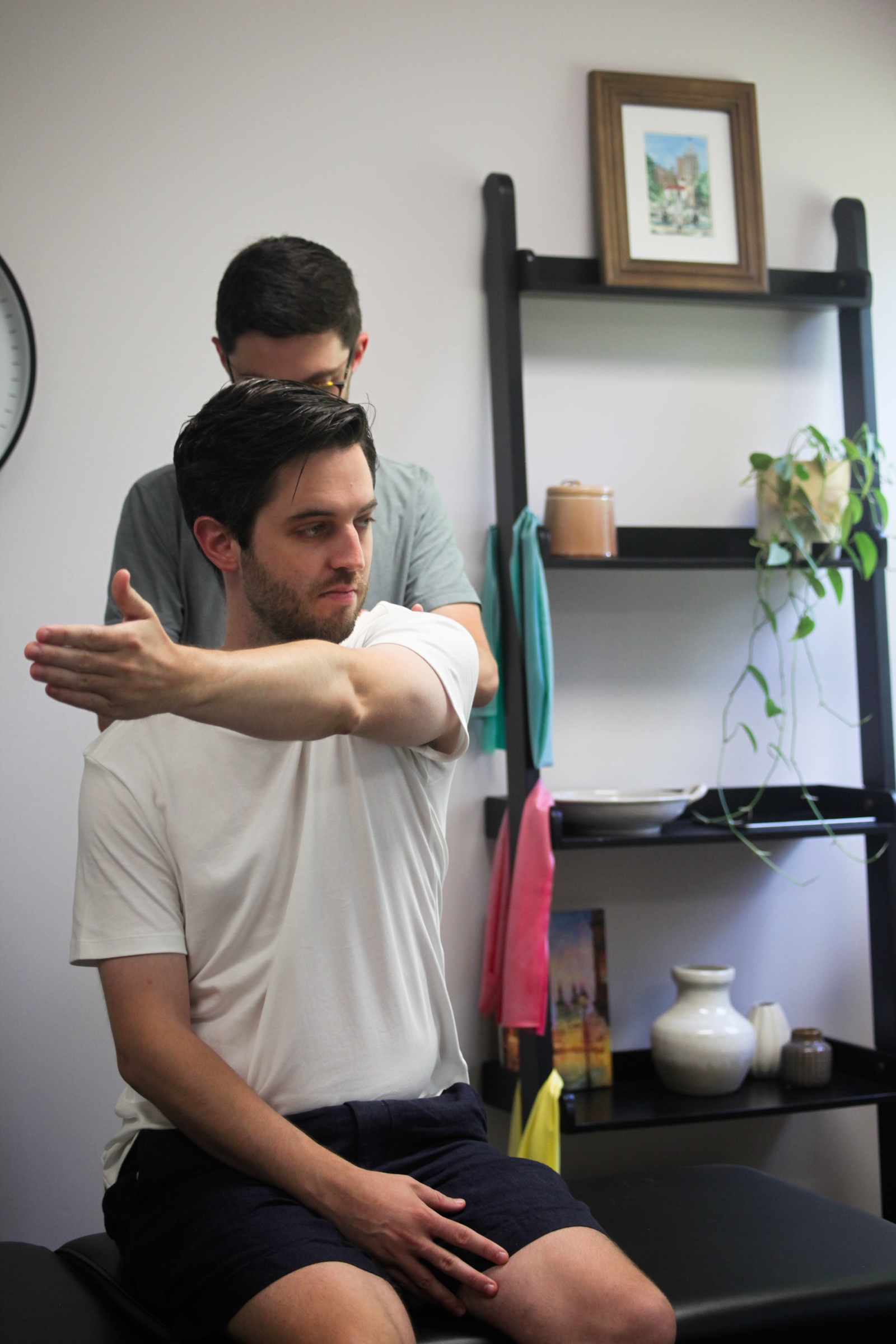
Most posture related discomfort responds to the things above within a couple of weeks. If it does not, that is worth knowing rather than pushing through.
Come in if the ache has lasted more than a few weeks, if it wakes you at night, if it is affecting your work or your sleep, or if you have numbness, tingling, or weakness anywhere in your arms or legs. Also come in if something feels distinctly one sided, because asymmetry usually has a reason and a better chair will not find it.
When someone comes to me about posture, most of what I do is figuring out which joints have stopped moving and which muscles stopped holding, then giving you two or three things to work on rather than twenty. Adjustments help restore movement where it has been lost. The homework is what keeps it.
If your neck or lower back has been complaining and you would like someone to look at why, give us a call at (913) 400-2014 or book online.