

Most of my older patients don't come in asking to be pain free. They come in because something they used to do without thinking has gotten hard. Backing the car out means turning the whole torso now. Getting up from a low chair takes a second attempt. Chiropractic care for seniors, the way I approach it, is aimed squarely at that: keeping you moving well enough that the ordinary parts of your day stay ordinary.
Pain matters, of course. But movement is usually the thing worth protecting, because it's the thing that quietly decides how independent the next ten years are.
What changes in the spine as we age

A few things happen, and none of them are a personal failing.
The discs between your vertebrae lose water content and get a little thinner. The joints in the back of the spine develop arthritic changes, which is essentially wear on the cartilage. Ligaments stiffen. Muscle mass declines, faster if you aren't using it. Your balance system gets less sharp.
Put those together and you get the pattern I see constantly: a spine that has lost some range, surrounded by muscles that have lost some strength, in a body that is a bit less confident on its feet. Each piece makes the others worse. Someone stiffens up, so they move less, so they get weaker, so moving feels harder still.
That loop is the real target. It's also the reason I don't think of an adjustment as the whole treatment. It's one input into breaking a cycle.
What chiropractic care for seniors actually looks like

It looks different from what I'd do with a thirty year old athlete, and it should.
The first visit is mostly listening and examining. I want to know about bone density, whether you've been told you have osteoporosis, what medications you're on (blood thinners matter), any joint replacements, any surgeries on your spine, and what your balance is like. That history genuinely changes what I do with my hands. If you want a sense of the format, I wrote about what to expect at your first chiropractic visit.
From there, care is usually lower force and more targeted. There are plenty of ways to restore movement to a stiff joint that don't involve a fast thrust, and with older patients I lean on those more often. Some of it is hands-on work on the joint, some is soft tissue work on the muscles that have tightened up around it, and a good share of every visit is showing you something to do at home.
If a forceful technique isn't appropriate for your bone health, I won't use one. That's not a limitation on the care, it's just what matching treatment to the patient means.
Mobility and strength are the same project

This is the part I push hardest, and it's the part patients are most surprised by.
Loosening a stiff joint feels good, but if nothing is holding that new range in place, you'll be stiff again in a week. Strength is what holds it. And strength is the single most protective thing an older adult can build, because it's what stands between a stumble and a fall.
You don't need a gym. Sitting down and standing up from a dining chair, without using your hands, is a genuinely good exercise. So is carrying a bag of groceries a bit further than you have to. The NHS recommends that older adults do strength and balance work on at least two days a week on top of regular activity, and that guidance is worth reading.
The point is regularity, not intensity. Ten minutes most days beats a hard hour on Saturday, and it's far easier on a body that's already sore.
A simple routine to keep moving
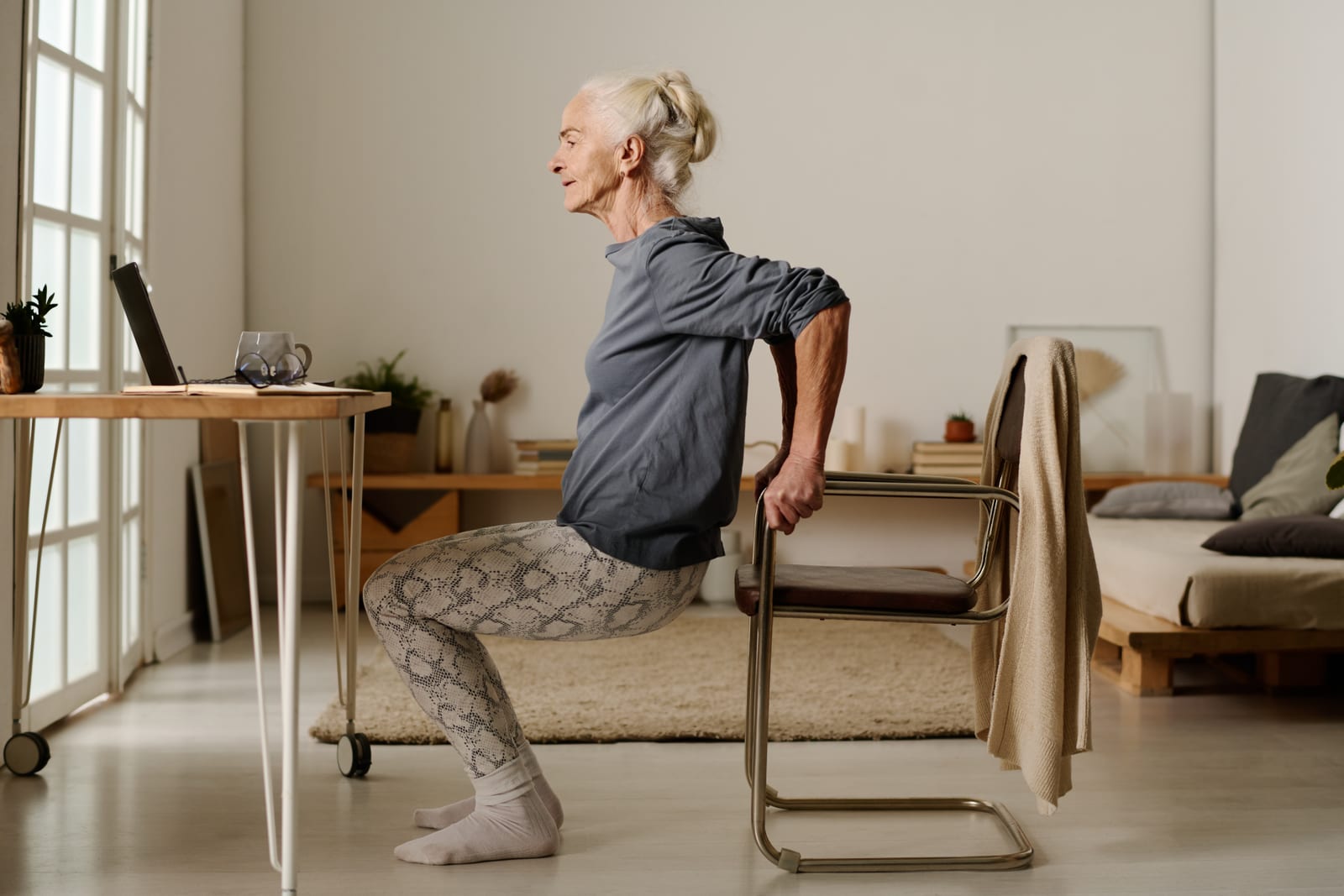
Do these gently, most days. Stop short of pain. None of them should be a struggle.
- Sit to stand. From a firm chair, stand up and sit back down five to ten times without pushing off with your hands. Use them if you need to at first.
- Seated marches. Sitting tall, lift one knee, then the other, twenty or so total. Easy on the hips and good for the core.
- Gentle trunk rotations. Seated, arms crossed over your chest, turn slowly to each side. Ten each way. This is the movement that makes reversing the car possible.
- Heel raises at the counter. Hold a countertop, rise onto your toes, lower slowly. Ten to fifteen. Good for calf strength and balance.
- Standing hip openers. Hand on the counter, swing one leg gently forward and back, then side to side. Ten each direction.
If your lower back is the main complaint, a few of my stretches for lower back pain fit in nicely here too, and my post on why your lower back hurts covers the usual culprits.
When to come in
If stiffness is getting in the way of things you want to do, that's reason enough. You don't have to be in bad pain to benefit from moving better.
Come in sooner if pain is waking you at night, if it came on after a fall, if you have numbness or weakness in an arm or leg, or if you've noticed your balance getting worse. Those deserve a proper look rather than a wait and see.
And a fair question I get a lot: no, you're not signing up for the rest of your life. I wrote about that in do you have to go to the chiropractor forever. With most of my older patients we work toward less frequent visits and more self-management, because that's what actually holds up.
At Tarry Chiropractic in Lenexa, I'll take the time to understand your history before I touch anything, and I'll be straight with you about what care can and can't do. Give us a call at (913) 400-2014 or book online.